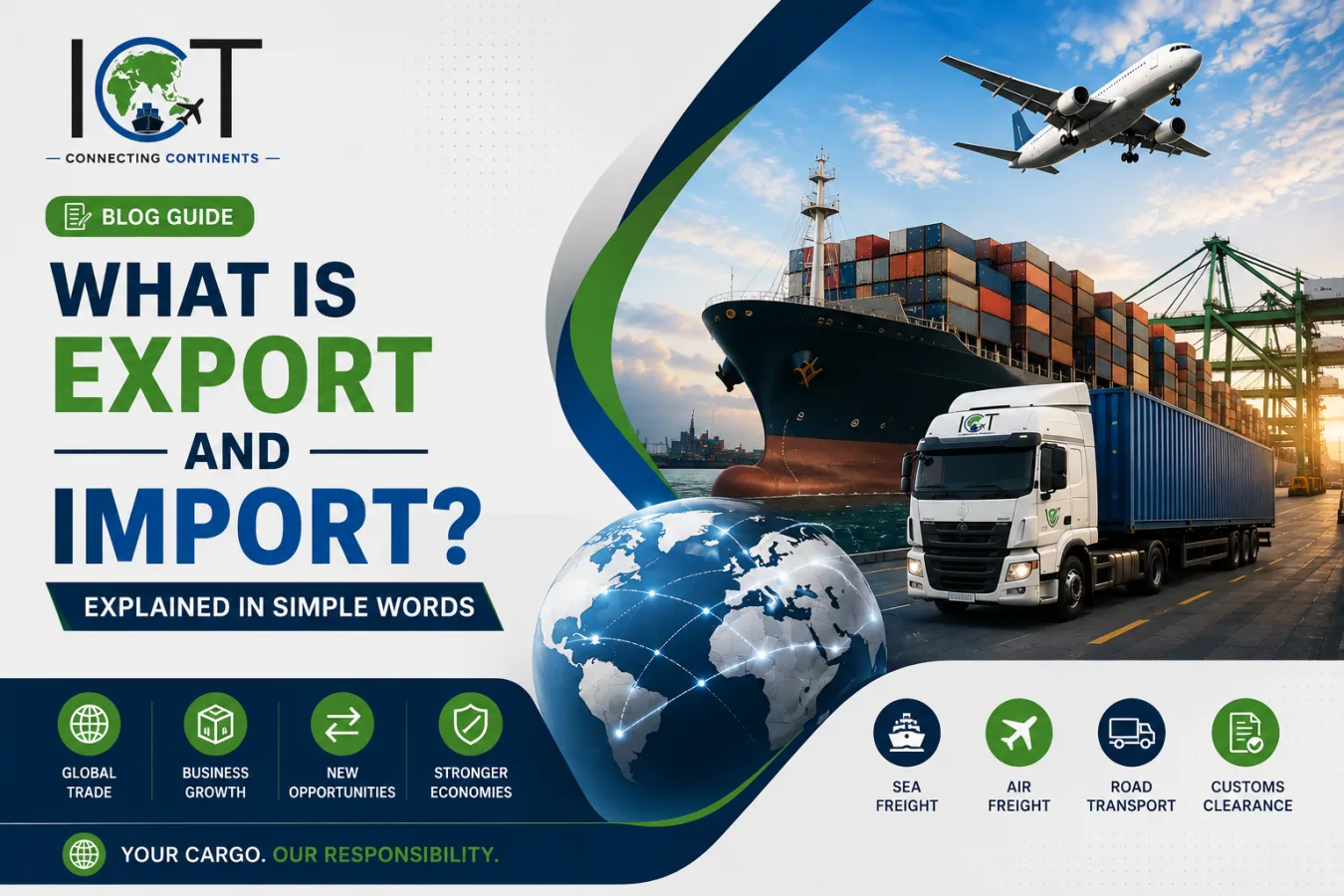
Almost every product we use has some connection with international trade. A mobile phone may be manufactured in one country, its components produced in several others, and the finished product sold around the world. Similarly, Pakistani rice, textiles, sports goods, surgical instruments, and other products are shipped to buyers across international markets.
The movement of goods between countries is generally described through two basic terms: export and import.
Although these terms are frequently used in business and logistics, understanding exactly what they mean—and what happens after a company decides to export or import—is essential for anyone entering international trade.
This beginner-friendly guide explains export and import in simple words.
What is Export?
An export occurs when goods or services are sold from one country to a buyer in another country.
For example, suppose a textile manufacturer in Lahore receives an order from a customer in the United Kingdom. The manufacturer prepares the goods in Pakistan and ships them to the UK.
From Pakistan's perspective, this transaction is an export.
Businesses export products for several reasons, including:
- Reaching international customers
- Increasing sales opportunities
- Entering new markets
- Expanding beyond domestic demand
- Building an international brand
Exporting allows a business that originally serves a local market to potentially reach customers around the world.
Pakistan-Based Export Example
Consider a Pakistani company selling garments to a buyer in Dubai.
The basic movement may look like this:
Manufacturer in Pakistan → Export Customs → Freight Transportation → UAE Customs → Buyer in Dubai
The exporter prepares the cargo and required documents. After completing export formalities, the goods may travel by sea or air depending on the shipment's size, urgency, cost, and other requirements.
For larger commercial shipments, our Sea Freight Services can provide FCL and LCL options across international trade lanes.
In-page link: Explore Sea Freight Services
What is Import?
An import is essentially the opposite of an export.
Importing occurs when a person or business purchases goods or services from another country and brings them into their own country.
For example, if a business in Pakistan purchases machinery from China and brings it into Pakistan, the transaction is an import for Pakistan.
Businesses commonly import goods when:
- Products are unavailable locally
- Overseas suppliers offer specialized products
- Raw materials are required for manufacturing
- Foreign equipment or technology is needed
- International sourcing provides commercial advantages
Imports therefore play an important role in manufacturing, retail, infrastructure, technology, and many other industries.
Pakistan-Based Import Example
Suppose a manufacturer in Lahore purchases industrial machinery from China.
A simplified process could be:
Supplier in China → Export Processing → International Transportation → Pakistan Customs → Local Transportation → Importer's Facility
Once the shipment arrives in Pakistan, the necessary import and customs procedures must be completed before the goods can be released.
In-page link: Learn About Our Customs Clearance Services
ICT provides in-house customs clearance alongside sea, air, road, and other freight services as part of its one-window logistics model.
Export vs Import: What's the Difference?
The easiest way to remember the difference is to look at the direction in which the goods are moving.
| Export | Import |
|---|---|
| Goods move out of a country | Goods move into a country |
| Seller is generally the exporter | Buyer is generally the importer |
| Used to sell products overseas | Used to source products overseas |
| Generates international sales | Provides access to foreign goods |
For example:
Pakistan → UAE = Export from Pakistan
UAE → Pakistan = Import into Pakistan
The same transaction can therefore be viewed differently depending on which country you are considering.
How Does the Export Process Work?
While requirements vary according to the product and destination, a typical export shipment follows several basic stages.
Step 1: Buyer and Seller Agree on the Transaction
The exporter and international buyer agree on the product, quantity, price, payment terms, delivery conditions, and applicable Incoterms.
Step 2: Goods Are Prepared
The exporter manufactures or prepares the cargo and ensures that it is properly packed for international transportation.
Step 3: Export Documents Are Prepared
Depending on the shipment, documentation may include:
- Commercial Invoice
- Packing List
- Bill of Lading or Air Waybill
- Certificate of Origin
- Goods Declaration
- Product-specific certificates
Related Article: What Documents Are Required for Export from Pakistan?
Step 4: Freight is Arranged
The exporter or buyer arranges transportation according to the agreed Incoterms.
Cargo may travel through sea freight, air freight, road transport, or a combination of different modes.
In-page links: Explore Sea Freight | Explore Air Freight
Step 5: Export Customs Clearance
The shipment must complete the applicable customs procedures before departure.
Step 6: International Transportation
After clearance and loading, the cargo begins its journey toward the destination.
Step 7: Destination Clearance and Delivery
Once the goods arrive, import procedures are completed at the destination and the cargo is eventually released for delivery to the buyer.
How Does the Import Process Work?
Importing follows the same international supply chain from the buyer's perspective.
A typical importer will:
- Identify an overseas supplier.
- Finalize the purchase and Incoterms.
- Arrange the required documentation.
- Coordinate international transportation.
- Complete import customs formalities.
- Pay applicable duties and taxes.
- Arrange cargo release and final delivery.
The exact requirements depend heavily on the country, commodity, HS code, regulations, and terms of the transaction.
This is why businesses should understand the applicable requirements before cargo is shipped rather than trying to resolve documentation or compliance problems after arrival.
Where Does a Freight Forwarder Fit In?
International trade involves multiple parties: exporters, importers, shipping lines, airlines, customs authorities, transporters, terminals, warehouses, and sometimes banks and inspection authorities.
A freight forwarder coordinates these different stages on behalf of the shipper.
A freight forwarding company may assist with:
- Route planning
- Sea and air freight bookings
- Documentation coordination
- Customs clearance
- Inland transportation
- Shipment visibility
- Final delivery coordination
Related Article: What is a Freight Forwarder and How Does It Work?
For businesses that would rather deal with one logistics partner instead of coordinating multiple providers separately, Inter-Continent Transport provides one-window support covering sea freight, air freight, road transportation, customs clearance and specialized logistics.
Important Tips for New Importers and Exporters
Before entering international trade, businesses should:
- Research the destination or origin market carefully.
- Verify the buyer or supplier.
- Understand applicable Incoterms.
- Identify the correct HS code.
- Confirm customs and regulatory requirements.
- Prepare documents accurately.
- Compare freight options before booking.
- Understand all expected logistics costs.
- Allow enough time for customs and transportation.
- Work with experienced logistics professionals.
Most importantly, do not treat freight as the final step of the transaction. Logistics should be considered while negotiating the deal because transportation costs, Incoterms, documentation requirements, and transit times can directly affect profitability.
Export and Import Made Simpler with the Right Logistics Partner
Export and import may appear complicated at first because several processes happen between the seller and buyer.
However, the fundamental concept is simple:
Export = selling and sending goods to another country.
Import = purchasing and bringing goods from another country.
The complexity lies in managing everything between those two points—documentation, customs, transportation, compliance, tracking, and delivery.
Inter-Continent Transport combines experienced operators with sea, air, road, customs and specialized freight capabilities, giving businesses a single point of coordination for international shipments.
Planning an Import or Export Shipment?
Whether you're sending cargo overseas or bringing goods into Pakistan, proper planning can help reduce delays, control costs, and keep your supply chain moving.
Contact Inter-Continent Transport for reliable freight services and a logistics solution tailored to your shipment.