International shipping involves several costs, responsibilities, and risks that buyers and sellers must understand before finalizing a transaction. One of the most important decisions in international trade is selecting the appropriate shipping term.
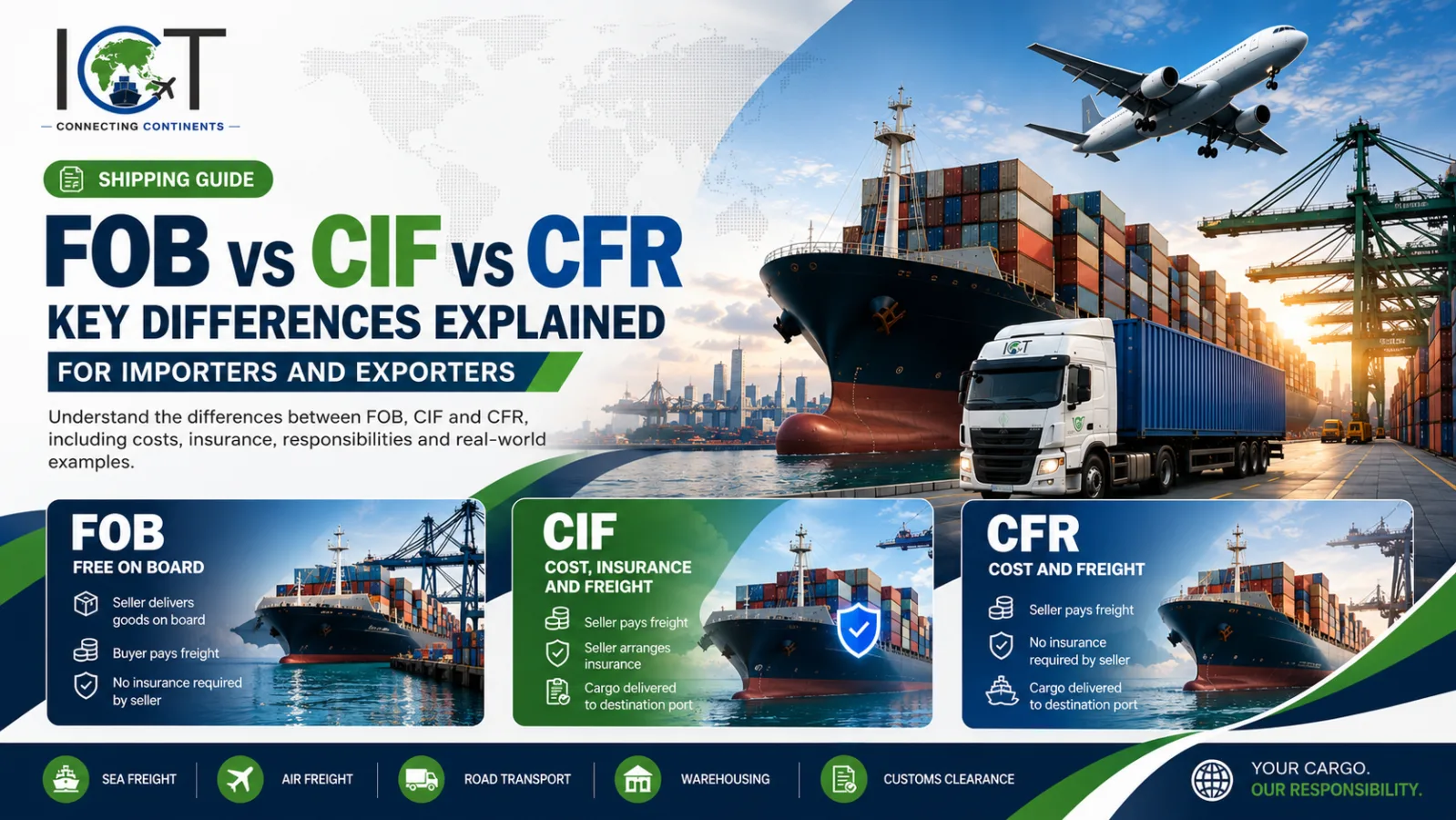
Three commonly used terms in ocean freight are FOB (Free on Board), CIF (Cost, Insurance and Freight), and CFR (Cost and Freight).
Although these terms may appear similar, they determine which party arranges and pays for international transportation, who arranges insurance, and when the risk of cargo loss or damage transfers from the seller to the buyer.
For exporters and importers in Pakistan, understanding these differences is essential for preparing accurate quotations, controlling shipping expenses, and avoiding unexpected costs.
In this guide, we explain FOB, CIF, and CFR in simple terms, compare their responsibilities, and provide practical examples of shipments moving between Pakistan and international markets.
What Are FOB, CIF and CFR in Shipping?
FOB, CIF, and CFR are international commercial terms governed by Incoterms® 2020, published by the International Chamber of Commerce (ICC).
These three terms are specifically intended for sea and inland waterway transportation.
They establish important responsibilities between the buyer and seller, particularly regarding:
Delivery of goods
Export customs clearance
International freight arrangements
Transportation costs
Cargo insurance requirements
Transfer of transportation risk
Understanding these responsibilities allows businesses to negotiate shipping arrangements more effectively.
For a broader explanation of international shipping terms, read our related article: What Are Incoterms in Shipping? Complete 2026 Guide.
1. What Is FOB (Free on Board)?
FOB stands for Free on Board.
Under FOB terms, the seller is responsible for delivering the goods on board the vessel nominated by the buyer at the agreed port of shipment.
Once the goods are on board, the risk of loss or damage transfers from the seller to the buyer.
The buyer generally arranges and pays for the main ocean freight.
Seller's Responsibilities Under FOB
The seller is generally responsible for preparing and packaging the goods, arranging transportation to the port, completing export customs clearance, and delivering the cargo on board the nominated vessel.
Buyer's Responsibilities Under FOB
The buyer generally arranges and pays for ocean freight, handles insurance if desired, completes destination import formalities, pays applicable import duties and taxes, and arranges onward transportation.
Example: FOB Karachi to Jebel Ali
Suppose a textile exporter in Lahore sells a container of fabric to a buyer in Dubai under:
FOB Karachi, Pakistan — Incoterms® 2020
The exporter arranges transportation from Lahore to Karachi, completes export formalities, and ensures the goods are loaded on board the nominated vessel.
The buyer arranges the ocean freight from Karachi to Jebel Ali.
FOB can be suitable when the buyer prefers to control the main ocean freight arrangements.
However, for containerized cargo handed over to a carrier at a terminal before vessel loading, FCA may be a more appropriate Incoterm because the point of delivery differs.
2. What Is CIF (Cost, Insurance and Freight)?
CIF stands for Cost, Insurance and Freight.
Under CIF, the seller arranges and pays for ocean freight to the named destination port and must also obtain the required cargo insurance.
However, an important distinction must be understood:
Under CIF, risk transfers to the buyer when the goods are loaded on board the vessel at the origin port, even though the seller pays freight and insurance to the destination port.
This is one of the most commonly misunderstood aspects of CIF shipping.
Seller's Responsibilities Under CIF
The seller generally handles export preparation, export clearance, loading on board the vessel, payment of ocean freight to the named destination port, and arranging the required marine cargo insurance.
Under Incoterms® 2020, CIF requires a minimum level of insurance coverage unless the parties agree otherwise.
Buyer's Responsibilities Under CIF
The buyer generally handles destination import customs clearance, applicable duties and taxes, destination handling costs not included in the seller's carriage contract, and onward transportation.
Example: CIF Karachi to Jebel Ali
A Pakistani exporter sells a container of goods under:
CIF Jebel Ali, UAE — Incoterms® 2020
The exporter arranges the ocean freight and required insurance to Jebel Ali.
The buyer handles the applicable destination import procedures and subsequent delivery.
CIF may be convenient when the buyer prefers the seller to arrange the main freight and insurance.
3. What Is CFR (Cost and Freight)?
CFR stands for Cost and Freight.
Under CFR, the seller arranges and pays for transportation to the named destination port.
However, unlike CIF, the seller is not required to arrange cargo insurance.
As with FOB and CIF, risk transfers to the buyer when the goods are loaded on board the vessel at the origin port.
Seller's Responsibilities Under CFR
The seller generally prepares the goods, completes export clearance, delivers the cargo on board the vessel, and arranges and pays for ocean freight to the named destination port.
Buyer's Responsibilities Under CFR
The buyer generally arranges insurance if required, handles import clearance, pays applicable destination duties and taxes, and arranges onward delivery.
Example: CFR Karachi to Jebel Ali
A Pakistani exporter agrees to ship goods under:
CFR Jebel Ali, UAE — Incoterms® 2020
The exporter arranges and pays for ocean transportation to Jebel Ali.
The buyer carries the transportation risk from the point of loading on board the vessel and should consider arranging insurance accordingly.
FOB vs CIF vs CFR: Key Differences
The following table summarizes the main differences between these three shipping terms.
Responsibility | FOB | CIF | CFR |
|---|---|---|---|
Export customs clearance | Seller | Seller | Seller |
Loading on board at origin | Seller | Seller | Seller |
Main ocean freight | Buyer | Seller | Seller |
Seller-required cargo insurance | No | Yes | No |
Risk transfers on board at origin | Yes | Yes | Yes |
Import customs clearance | Buyer | Buyer | Buyer |
Import duties and taxes | Buyer | Buyer | Buyer |
The most important difference is the allocation of freight and insurance costs, not the point of risk transfer.
Under all three terms, risk transfers when the goods are on board the vessel at the port of shipment.
Understanding Shipping Costs: A Practical Example
Consider a Pakistani exporter selling goods to a customer in the UAE.
Assume the following hypothetical costs:
Cost Component | Amount |
|---|---|
Goods value | USD 15,000 |
Export-side transportation and handling | USD 500 |
Ocean freight | USD 1,200 |
Cargo insurance | USD 100 |
Assuming these amounts are the agreed seller-side costs, the illustrative quotation values would be:
FOB
$15,500 Goods + origin costsCFR
$16,700FOB + ocean freightCIF
$16,800CFR + insuranceThese figures are illustrative and not actual market freight quotations. Commercial quotations may also include margins, financing costs, and other agreed expenses.
This example demonstrates why the selected Incoterm can significantly affect the quoted selling price.
Which Is Better: FOB, CIF or CFR?
There is no single shipping term that is best for every transaction.
The appropriate choice depends on the buyer's and seller's experience, commercial agreement, insurance preferences, and ability to arrange freight.
When FOB May Be Suitable
FOB may be suitable when the buyer has an established freight forwarding network and prefers to arrange the main ocean transportation.
It gives the buyer greater control over carrier selection and freight negotiations.
When CIF May Be Suitable
CIF may be suitable when the buyer wants the seller to arrange ocean freight and the required insurance.
However, buyers should carefully review the insurance coverage and understand that CIF does not mean the seller bears the transportation risk until arrival.
When CFR May Be Suitable
CFR may be appropriate when the seller can arrange competitive ocean freight while the buyer prefers to arrange its own cargo insurance.
Regardless of the selected term, both parties should clearly understand the commercial and operational responsibilities before confirming the shipment.
Common Mistakes Businesses Make When Using FOB, CIF and CFR
Misunderstanding shipping terms can lead to financial disputes, delays, and unexpected logistics expenses.
One common mistake is assuming that the party paying ocean freight also bears the transportation risk until arrival. Under CIF and CFR, this is not the case.
Another mistake is failing to specify the named port. Writing only "FOB" or "CIF" without identifying the relevant port can create uncertainty.
Businesses should also avoid assuming that CIF includes all destination charges, import duties, or final delivery expenses.
Finally, containerized shipments should be evaluated carefully because the physical point of cargo handover may make FCA or CPT/CIP more appropriate than traditional FOB, CFR, or CIF arrangements.
How a Freight Forwarder Helps with FOB, CIF and CFR Shipments
An experienced freight forwarder can help importers and exporters understand the transportation implications of different Incoterms.
This includes arranging freight quotations, coordinating carrier bookings, organizing documentation, managing customs clearance, and arranging inland transportation.
For example, a Pakistani exporter preparing a CIF quotation needs to understand the ocean freight and insurance costs before confirming the selling price.
Similarly, a buyer purchasing goods under FOB may require a freight forwarding partner to arrange transportation from the port of shipment.
Inter-Continent Transport (ICT) supports international shipping operations through its sea freight, air freight, customs clearance, road transportation, and warehousing services.
By coordinating multiple logistics requirements through a single service provider, businesses can simplify shipment planning and reduce administrative complications.
Frequently Asked Questions
Does CIF include customs duties?
Generally, no. Under CIF, the buyer is responsible for import customs clearance and applicable duties and taxes at the destination.
Is FOB cheaper than CIF?
An FOB quotation is generally lower because it does not include the seller arranging and paying the main ocean freight and required insurance. However, the buyer still needs to account for these costs when calculating the overall shipment expense.
Who pays ocean freight under CFR?
The seller arranges and pays the ocean freight to the named destination port.
Who is responsible for insurance under FOB?
Neither party is required by the FOB rule itself to obtain insurance. The buyer commonly arranges coverage for the transportation risk it assumes, although insurance responsibilities may be addressed separately in the sales contract.
Can FOB, CIF and CFR be used for air freight?
No. These three Incoterms are intended for sea and inland waterway transportation. For air freight, terms such as FCA, CPT, or CIP may be more appropriate depending on the transaction.
Conclusion
Understanding the difference between FOB, CIF and CFR is essential for making informed decisions in international shipping.
While all three terms are widely used in ocean freight, their main differences relate to which party arranges and pays for transportation and insurance.
For exporters and importers in Pakistan, selecting the correct shipping term can help improve quotation accuracy, clarify responsibilities, and reduce avoidable disputes.
Before confirming an international shipment, businesses should review their commercial terms carefully and ensure that all parties understand their obligations.
Need Assistance with Your Next Shipment?
Whether your cargo is moving under FOB, CIF, CFR or another Incoterm, Inter-Continent Transport can assist with freight forwarding, customs clearance, and transportation arrangements.
Contact Inter-Continent Transport for reliable freight services.
Website: www.ictcnl.com
Recommended Internal Linking
Add these contextual links when publishing the article:
What Are Incoterms in Shipping? Complete 2026 Guide — link from the introduction and the Incoterms explanation.
What Is a Freight Forwarder and How Does It Work? — link from the freight forwarder section.
Sea Freight Services — link from the FOB and CFR sections.
Documents Required for Export from Pakistan — link from the documentation discussion.
Contact / Get a Quote — link from the final CTA.
Use the actual published page URLs in your CMS rather than creating unverified slugs.